
Setting a new testing standard in the battle against polio | Takeda Stories
Setting a new testing standard in the battle against polio
The transition to a new, safer strain of poliovirus in quality-control testing of human immunoglobulins reduces the risk of a renewed spread of the disease.
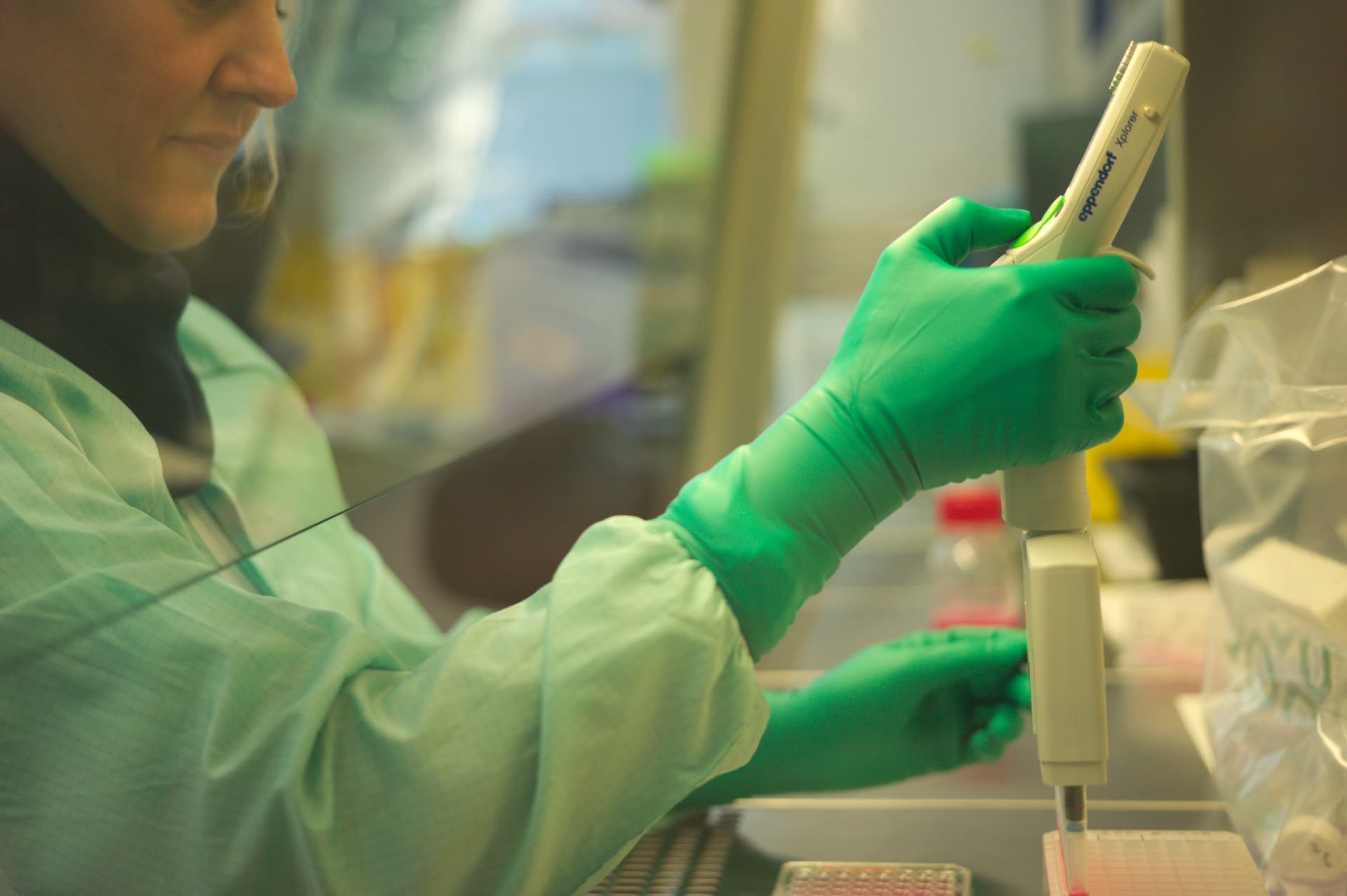
Scientists don’t often get the chance to help eradicate a centuries-old disease. But our Global Pathogen Safety team in Vienna has done just that – by replacing the infectious wild-type poliovirus (WPV) once required for quality-control testing of human immunoglobulin treatments with a safer, fully compliant alternative.
Approval by the U.S. Food & Drug Administration (FDA) for the new, safer S19 poliovirus strain in immunoglobulin quality-control testing means that all of Takeda’s remaining WPV stocks have been safely destroyed. Alongside vaccination and surveillance, the containment and eventual elimination of laboratory WPV has long been seen as one of the key goals in efforts to completely eradicate polio.

Birgit Prochazka, head of Austria’s National Reference Center for Poliovirus at AGES
Birgit Prochazka, the head of Austria’s National Reference Center for Poliovirus at AGES (Austrian Agency for Health and Food Safety) in Vienna and National Polio Containment Coordinator, has no doubts about the impact of Takeda’s achievement. “The significance of transitioning to S19 and the simultaneous disposal of WPV stocks is huge,” she says. “WPV represents the greatest potential source of a renewed spread of polio. The risk of infection in the event of a laboratory accident is much lower with S19, so the probability that the virus could establish itself in the environment or spread further is greatly reduced.
“I congratulate the Takeda team for their excellent performance and great work.”
Thomas R. Kreil, Takeda’s global head of pathogen safety, explains why the transition is so much more than a simple process change. “The initiative to eliminate poliovirus globally is probably the biggest public health intervention ever,” he says.
“Being able to contribute meaningfully to this effort is a hugely rewarding personal, as well as professional, accomplishment for our committed and highly skilled team. It removes a high-risk pathogen from laboratories, so it protects employees and communities. It demonstrates our leadership in science-based risk reduction, and it sets a precedent for the plasma-derived therapies industry.”
The power of collaboration to solve WPV challenge

Thomas R. Kreil, Takeda’s global head of pathogen safety
Poliomyelitis (polio) is a highly infectious viral disease that largely affects children under 5 years of age. The virus is transmitted by person-to-person and multiplies in the intestine. From there, it can invade the nervous system and cause paralysis.1
Under the leadership of the World Health Organization (WHO) and the Global Polio Eradication Initiative (GPEI), which involves national governments and other international health organizations, cases of polio worldwide have fallen by more than 99% since 1988. As of 2022, endemic WPV transmission is now confined to just two countries – Afghanistan and Pakistan.1
As long as regulators required the use of infectious WPV in immunoglobulin quality-control testing, however, complete eradication would remain an unattainable goal.
The solution to this challenge has been found through collaboration. We evaluated and qualified the new S19 strain that had been developed by the UK’s National Institute for Biological Standards and Control (NIBSC).2 Collaborating closely with the NIBSC, our scientists found it to be a genetically stable, safe virus variant that demonstrates equivalent performance to WPV in neutralization assays.3
The study was published in 2018,3 providing a foundation for regulatory acceptance of S19 as an alternative to WPV. This was confirmed by the U.S. Centers for Disease Control and Prevention early in 2026.4
We completed the transition to S19 on March 11, following U.S. FDA approval, with destruction of our remaining WPV stocks safely completed at the beginning of May.
“The initiative to eliminate poliovirus globally is probably the biggest public health intervention ever. Being able to contribute meaningfully to this effort is a hugely rewarding professional accomplishment for our committed and highly skilled team.”
Beatrice Biebuyck, Takeda’s head of global regulatory affairs for plasma-derived therapies, leads the regulatory team responsible for the FDA submission of the S19 polio alternative to the FDA, and for gaining approval for the transition from WPV in immunoglobulin lot-release testing as defined by the U.S. Code of Federal Regulations (CFR). "This was a complex process,” she explains, “because it involved satisfying a decades old statutory potency requirement through a new scientific approach, without reducing standards.”
Beatrice adds: “We had to demonstrate through extensive side-by-side comparability data that the safer S19 strain produced the same functional testing outcomes as the original wild-type assay, that it could still detect subtle drops in antibody potency and that it would remain reliable over time as population immunity changes.
“Because this test is directly tied to product release and patient safety, the FDA reviewed the submission with exceptional rigor to ensure protection was fully preserved. The result eliminated wild type poliovirus from our operations while maintaining full CFR compliance, strengthening biosafety and containment goals and setting a product specific, science earned regulatory precedent.”
Our transition from WPV to S19 in human immunoglobulin testing represents a small, but significant step in the battle to eliminate polio, a disease that can be traced back to ancient Egypt.5 As Thomas Kreil points out, it’s also another milestone for Takeda.
“We’ve been meeting patient needs and helping improve public health for more than 240 years,” he says. “This latest achievement is a continuation of that proud history.”

References
- Poliomyelitis (polio); The World Health Organization: https://www.who.int/health-topics/poliomyelitis#tab=tab_1
- Knowlson S, Burlison J, Giles E, Fox H, Macadam AJ, Minor PD. New strains intended for the production of inactivated polio vaccine at low-containment after eradication. 2015. PLoS Pathog. 11(12):e1005316. doi/10.1371/journal.ppat.1005316
- Farcet MR, Modrof J, Rabel PO, Schirmer A, Macadam AJ, Fox H, Minor PD, Kreil TR. Continued use of poliovirus after eradication: hyper-attenuated strains as a safe alternative for release testing of human immunoglobulins. 2018. Transfusion 58 (S3), 3084-89. doi/10.1111/trf.15048
- Wiese N, Hendley W, Jafri B, Jones KAV, Sifontes G, Valdez S, Zhang Y, Mainou BA. Evaluation of hyper-attenuated S19 poliovirus strains for use in poliovirus neutralization assays. 2026. PLoS One 21(2):e0343816. doi/10.1371/journal.pone.0343816
- History of Polio; Global Polio Eradication Initiative: https://polioeradication.org/about-polio/history-of-polio/

Share this story