
How sustainability strengthens health and business | Takeda Stories
How environmental sustainability strengthens health and business
Our global manufacturing & supply officer shares how environmental sustainability actions improve business performance and supply continuity for patients.

Planetary health and human health are inseparable. When air is polluted, water is scarce and ecosystems are stressed, the effects are felt in communities and across the natural systems we rely on to develop and deliver medicines. That’s why we address our environmental impact through a holistic strategy across our value chain, supporting both human health and long-term business resilience.
How are we reducing emissions?
To date, more than 20 of our manufacturing sites have made measurable progress through our in-house climate action program.
In Vienna, where we produce plasma-derived therapies for patients in more than 100 countries, we worked with the Austrian Institute of Technology to develop carbon dioxide-free steam generation for industrial processes. The result was AHEAD (Advanced Heat Pump Demonstrator), a first-of-its-kind innovative heat-pump that uses 100% natural refrigerants to turn waste heat into energy. The system can produce CO2-free steam at 11 bar(a) and above 184°C for seven months of the year, with the potential to reduce carbon emissions from the process by up to 80%. The insights from AHEAD are openly shared to help accelerate adoption across industries.
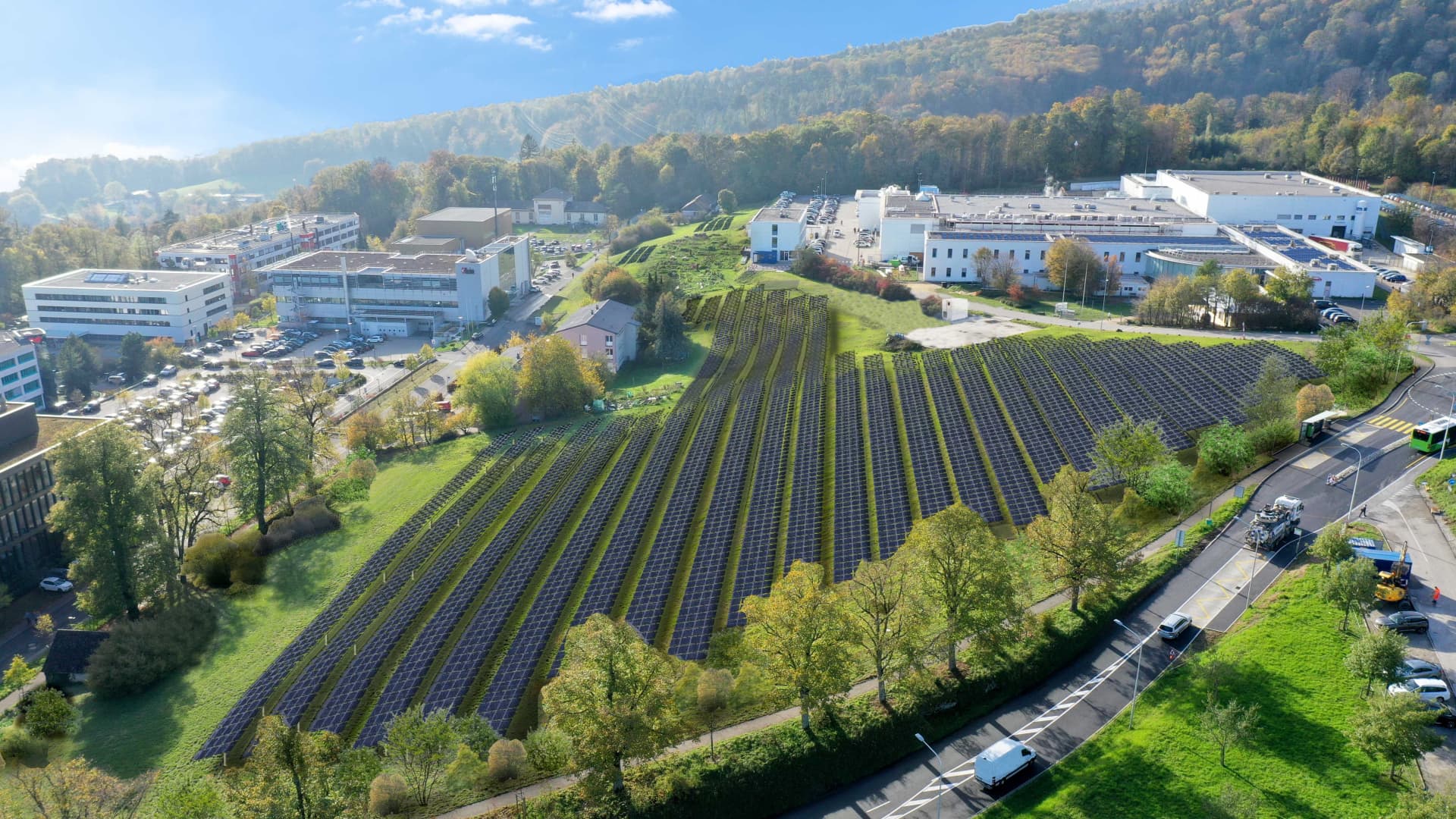
We’ve also expanded the use of renewable energy. More than 20 sites have installed photovoltaic solar power arrays, generating over 6 GWh of electricity at locations including Neuchâtel, Switzerland, and Thousand Oaks, CA, U.S. Additional electricity used at our sites in Europe, the U.S. and Japan is sourced as renewable energy or through virtual power purchase agreements (Europe, U.S.). Together, these efforts have reduced operational greenhouse gas (GHG) emissions by 55% from our FY2016 baseline, supporting our goal of achieving net-zero* GHG emissions across our operations by FY2035.
We’re optimizing our distribution network by improving our air-to-sea freight ratio, which was 56.6% by sea in FY2025. Switching one of our products to sea freight reduced emissions by 17 and 12 tons of CO2e** per shipment on routes from Europe to Canada and Brazil, respectively, while also lowering costs. A similar shift for shipments between Europe and China reduced transportation costs by 65% and cut CO2e emissions by 980 tons, a 99% reduction compared with air freight.
Understanding that 90% of our GHG emissions come from our supply chain, we also encourage our suppliers to take action, providing them with practical solutions. For instance, we’re a founding member of Energize, a program that helps pharmaceutical suppliers purchase renewable energy.
“Environmental challenges are too big for anyone to address alone. We’re working collectively on actions that deliver real impact at scale, and we encourage others across the health care ecosystem – including our suppliers, partners and peers – to join us.”
How do we manage natural resources?
Our ability to deliver life-transforming treatments depends on nature, so we work to carefully manage natural resources.
Our site in Osaka, Japan, uses digital technology to visualize water usage in real time, helping to reduce freshwater withdrawal by 2 million liters and distilled water consumption by over 450,000 liters each year. At our Lessines site in Belgium, we recycle up to 90% of wastewater for reuse in our production processes – the equivalent annual water consumption of approximately 18,000 people in Belgium. Efforts like these have helped us reduce our global water withdrawal by 7% since FY2019, while continuing to expand our business. Our goal is to reach a 10% reduction by FY2030.
Our Hoover, Alabama and Covington, Georgia, sites in the U.S. use specialized equipment to sterilize and shred plastic bottles and test tubes, helping to prepare biomedical waste for recycling. In Covington alone, this process keeps more than 1.7 million pounds (approximately 771,000 kilograms) of waste from landfill each year. Initiatives like these have enabled us to divert 75% of our waste from landfill since FY2019, and our goal is to achieve zero waste to landfill by FY2030.
How are we making our products more sustainable?
Up to 80% of a product’s environmental impact is determined in the design phase, so we incorporate sustainability in the early stages of development. One way our efforts come together is through the My Green Lab® certification program, which equips teams in our R&D and quality labs to assess and address 14 categories of environmental sustainability.
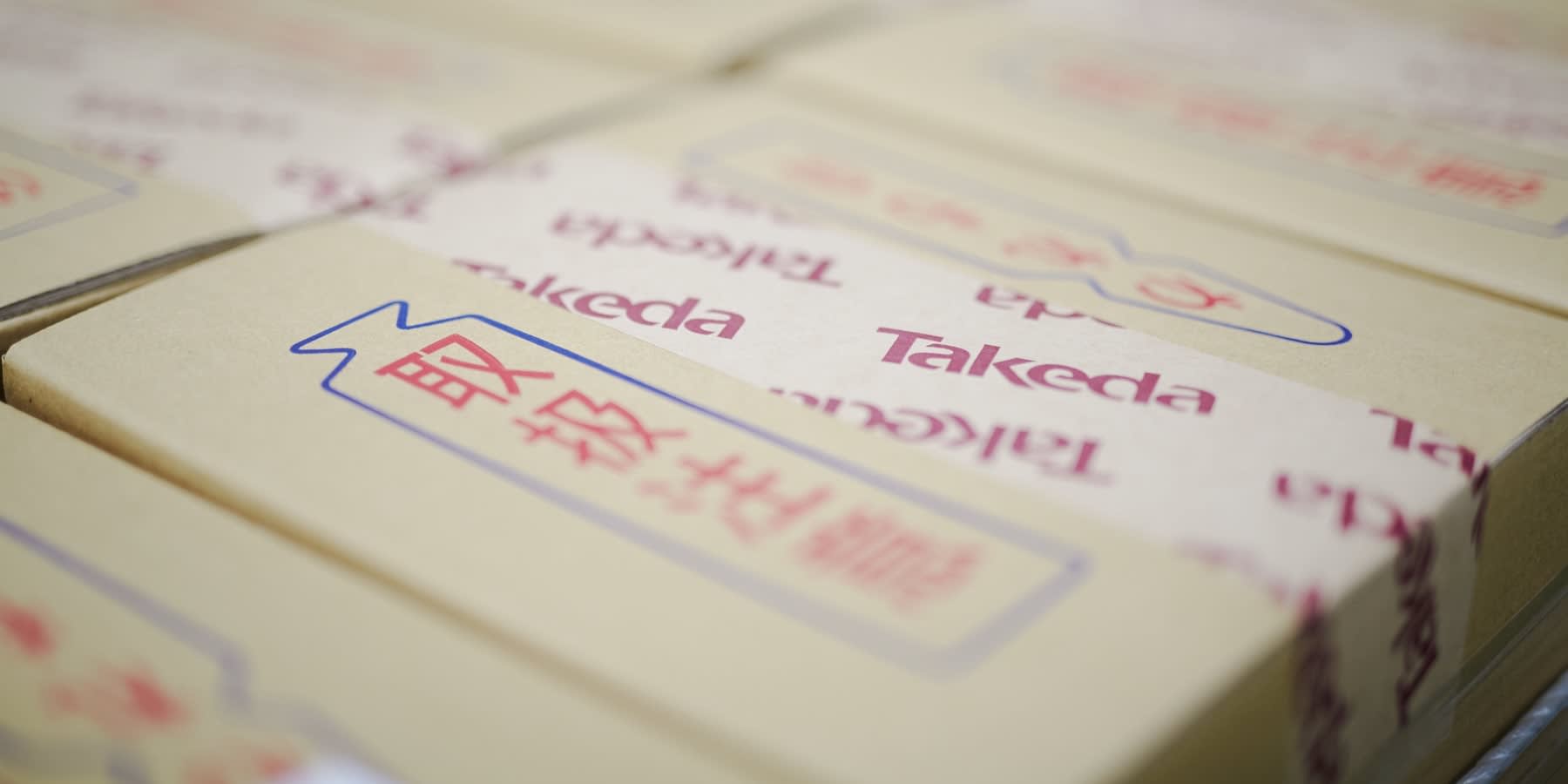
To make our product packaging more sustainable, we’re reducing weight, improving recyclability and prioritizing recycled paperboard and Forest Stewardship Council-certified materials. We’re also cutting paper use by moving to e-leaflets, which can improve the patient experience by making medicine information easier to access, including through screen reader apps for patients with visual impairments.
Today, 73% of our paper and paperboard is sourced from sustainable forests or recycled, and our target is to reach 95% by FY2030.
How do we deliver value?
Building a sustainable business requires ambition, bold action and the right partners. Our focus on climate, nature and product sustainability makes our operations more efficient, lowers costs and delivers meaningful environmental and health benefits – an approach that has helped Takeda earn a place on CDP’s Climate A List for four consecutive years.
Most importantly, our work recognizes the link between environmental and human health. These challenges are too big for any one company to solve alone, so we encourage our suppliers, partners and peers to work with us to create widespread impact. Working together, we can turn shared ambition into measurable progress for people, communities and the planet.
*Net-zero refers to a state in which the greenhouse gases going into the atmosphere are balanced by removal out of the atmosphere. Takeda follows the SBTi net-zero standard.
**Carbon dioxide equivalent, or CO2e, is a standardized unit used to measure the climate impact of various greenhouse gases.
Share this story